
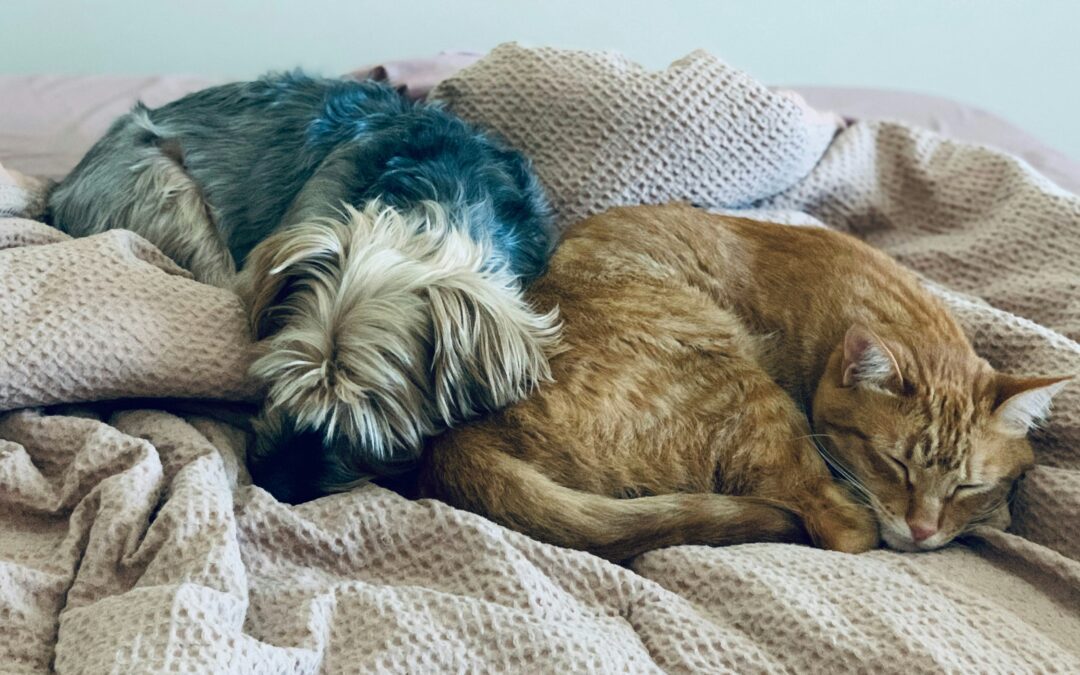
Having a puppy join a new family can be so much fun, but there are many factors to consider. Thoughtful planning can help keep a puppy safe in their new home. While this is an exciting time for the new owners and the puppy, an older household cat — who was likely quite content in a quiet environment — may feel otherwise.
Introducing new puppies to household cats should be done very carefully and slowly. One of the most common ocular injuries seen by veterinary ophthalmologists is a cat claw injury to the cornea that occurs when introducing a puppy to new housemates. Often, these injuries happen on the very first day the puppy is brought home.
A common scenario is that the puppy is left unsupervised or allowed to have a nose-to-nose “meet and greet.” Before you know it, the cat feels overwhelmed, and the wide-eyed, tail-wagging puppy suddenly shrieks and clamps his eyes closed. It happens in a flash. The puppy then presents to the veterinary office with a red eye that is tearing and tightly shut.
After an ophthalmic examination, it may be determined that there is indeed a scratch on the cornea from the cat’s claw. Distraught new puppy parents often ask, “How are we going to fix this?” Let’s review the likely scenarios.
Quite often, patients are placed on topical ophthalmic antibiotics if the scratch is superficial and does not penetrate all layers of the cornea. In these cases, the injury may heal with the assistance of topical medications.
However, if there is a gaping laceration or if the claw penetrates the full thickness of the cornea, fluid may leak from within the eye. In these cases, surgical intervention is often required. There are several surgical options to repair the cornea, ranging from suturing the laceration closed under a surgical microscope to grafting procedures, such as using donor corneal tissue to replace lost or damaged areas.
Once the cornea is repaired, there is often a sense of relief as healing progresses and the puppy regains comfort. New owners are grateful to know their puppy’s eye has been saved.
However, there is another significant concern that is often overlooked and may have delayed complications.
The hook shape of a cat’s claw, combined with the cat’s ability to rotate its forearms, allows deep penetration into the globe. In some cases, the claw can puncture the capsule that surrounds the lens.
This can lead to delayed cataract formation and lens-induced uveitis (inflammation). There are two types of lens-induced uveitis. A cataract may cause phacolytic uveitis, while a significant puncture through the lens capsule can cause phacoclastic uveitis. Both occur due to the release of lens proteins outside of the capsule, which triggers an immune-mediated response because these proteins are recognized as “foreign.” This reaction results in secondary intraocular inflammation.
If inflammation persists or intensifies, it can lead to a condition called endophthalmitis. These complications are devastating and may result in pain, blindness, or loss of the eye.
If inflammation and infection are not controlled, the puppy’s vision and/or eye may ultimately be lost.
For this reason, it is critical to perform a thorough ophthalmic examination to assess both the cornea and the lens after a cat claw injury. If a lens injury or significant corneal damage is suspected, prompt referral to a board-certified veterinary ophthalmologist is recommended for microsurgical repair and/or phacoemulsification to remove lens material and initiate appropriate anti-inflammatory therapy.
Addressing the injury quickly and thoroughly gives the puppy the best chance to maintain comfort and vision.